
Quality Documentation, Records & Traceability: Foundations for Compliance and Operational Control
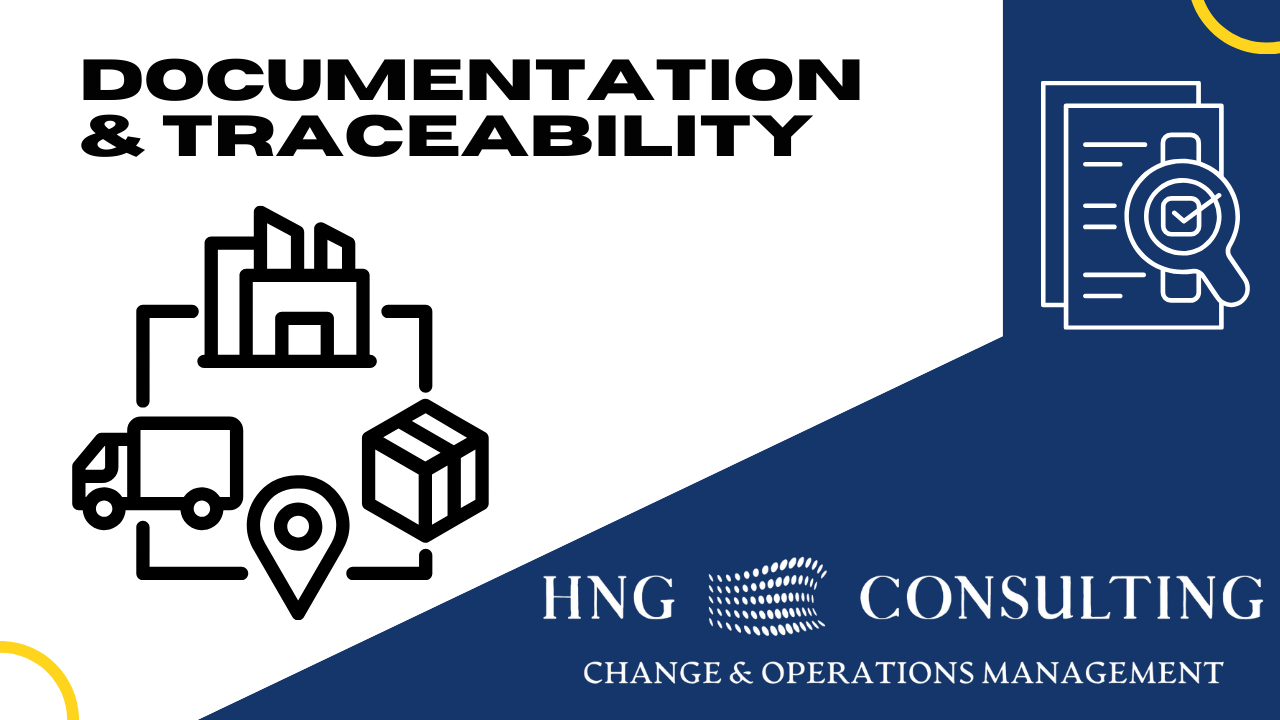
📂 Quality Documentation, Records & Traceability: The Infrastructure of Control
Documentation defines what should happen. Records prove it did. Traceability connects every output to its inputs — from raw material to final delivery. Together, these three form the data infrastructure that makes compliance verifiable, quality improvable, and recall risk manageable. Without them, you are operating blind.
📐 Documentation, Records, Traceability — What Each Does
📄 The Standard Every Operator Follows — or Does Not
-
1
Procedures and Work Instructions Step-by-step guidance for every critical process activity — written at the level of the operator, accessible at the workstation, updated when the process changes.
-
2
Quality Manuals and Policies The top-level framework that defines quality objectives, responsibilities, and the structure of the QMS — required by ISO 9001 and the foundation of every external audit.
-
3
Process Specifications and Control Plans Define the critical process parameters, tolerances, monitoring frequencies, and reaction plans for each production step — the engineering backbone of consistent output.
🗂️ Evidence + Thread — Proof and Origin
- Inspection & test resultsConformity proof
- Production & process dataExecution evidence
- Audit reportsSystem evidence
- Corrective action recordsImprovement trail
- Calibration recordsMeasurement validity
- Training recordsCompetence proof
- Raw material → supplierOrigin confirmed
- Batch → process stepRoute recorded
- Process → operatorAccountability
- Process → equipmentAsset link
- Product → inspection resultQuality confirmed
- Batch → customer deliveryRecall boundary
Continuous improvement is what turns a busy operation into a better one.
This course helps your teams move beyond firefighting and into a more structured, disciplined way of working, where problems are made visible, root causes are addressed, and improvement becomes part of everyday operations.
Using practical tools such as 5S, Kaizen Events, Lean thinking, and Value Stream Mapping, participants learn how to reduce waste, improve flow, and create a workplace that performs more consistently over time.
Rather than relying on constant urgent fixes, this course shows how to build a system that supports stability and long-term performance. It is designed for leaders and teams who want to strengthen execution, improve operational clarity, and create measurable gains that last.
The result is not just a cleaner process, but a more resilient organisation with stronger habits, better control, and a culture of continuous progress.
⚙️ Control, Consistency, and Crisis Response
💶 The Recall Math — Precision vs. Full-Lot Exposure
- Defect found in fieldBatch identified in hours
- Scope of recallSurgical — affected only
- Root cause analysisData-driven, fast
- Regulatory responseEvidence-ready
- Customer communicationPrecise, credible
- Defect found in fieldScope unknown
- Scope of recallFull lot or wider
- Root cause analysisGuess-based, slow
- Regulatory responseHigh non-conformity risk
- Customer communicationVague, trust-damaging
🎯 Rate Your System — Charts in Part 3 Update Live

📊 Your Documentation & Traceability System — Plotted from Part 2
🛠️ From Paper-Based Risk to Digital Control
-
1
Standardize Document Formats and Version Control One document per process, one version in circulation. Every outdated version immediately withdrawn at the point of use — paper or digital. Operators should never wonder which version applies.
-
2
Ensure Accessibility at the Point of Use A work instruction kept in a quality office does not guide the operator at the workstation. Documentation must be available exactly where the work is performed — physically or digitally.
-
3
Implement Digital Quality Management Systems eQMS platforms eliminate paper-based traceability gaps, automate version control, link records to process steps in real time, and make audit evidence retrieval a matter of seconds — not hours of searching.
-
4
Define Retention Periods and Traceability Requirements by Product Type Medical devices may require 10–15 year retention. Automotive parts: lifetime of vehicle plus service period. Define requirements per product class — not a single blanket policy — and build the system around them.
-
5
Link Traceability to Batch Numbers, Equipment IDs, and Operator Records A traceability chain is only as strong as its weakest link. If batch-to-equipment linkage breaks at one process step, the entire recall boundary becomes uncertain. Audit the chain end-to-end regularly.
🔄 You Cannot Improve What You Have Not Documented
Build a quality management system that does more than tick boxes.
This training gives your team the foundations to create a structured, practical QMS that improves consistency, reduces the cost of poor quality, and supports smarter decisions across the business. Covering ISO 9001, the 7 quality principles, PDCA, and the documentation framework behind an effective system, it helps you turn quality into a real operational advantage.
Designed for manufacturing leaders and quality teams, this module shows how to move from reactive problem-solving to a more disciplined, data-driven approach. The result is better control, clearer processes, stronger alignment, and a quality system that supports growth rather than slowing it down.
Why Partner with HNG Consulting?
At HNG Consulting, we help organizations implement structured documentation, records management, and traceability systems that support compliance, operational control, and financial performance.
Documentation system design
Development of structured documentation aligned with ISO 9001, IATF 16949, and industry requirements.
Traceability implementation
Design of traceability systems to track products, processes, and materials across the production lifecycle.
Audit readiness and compliance
Support in achieving audit readiness and maintaining compliance through controlled documentation and record systems.